




Given technology, speed and accuracy in algebraic manipulation no longer constitute legitimate priorities. However a grasp of the fundamental structures of algebra (the meaning of variables, operations, functions, equations) remains crucial. Intelligent use of manipulatives can help. They provide a hands-on approach where the inner logic of the model replaces the memorization of seemingly arbitrary rules.
The Lab Gear is a comprehensive manipulative environment I designed for the teaching and learning of algebra. I have written three books' worth of activities for it -- The Algebra Lab: High School, Algebra Lab Gear: Basic Algebra, and Algebra Lab Gear: Algebra 1. The first is available on this site. The other two, and the blocks, are available from Didax. (Scroll down for more on what to buy, or click here for info on where to order.)
For a full training on the Lab Gear, you can hire me to run an in-service or pre-service workshop. I can introduce the Lab Gear in one or two days, or incorporate that into a more general course on teaching algebra, which can run from two to five days. Or watch the introductory videos on this site.

On this site
Videos
Short videos, for the professional development of algebra and pre-algebra teachers: narrated slide shows of Lab Gear basics, including cool animations. Also: silent versions you can use in classroom discussion.
Applets
Explore and discuss: multiplying binomials, squaring a binomial, and completing the square using the Lab Gear model.
Virtual Lab Gear
Google Drawings that make it possible for students and teachers to carry out Lab Gear activities, to create Lab Gear images, and to project such images for classroom discussion. Figures can be annotated with text, and multiple people can work on the images at the same time.
Blog post about the Virtual Lab Gear, including an activity: "Trains and Towers".
Articles
How one middle school teacher uses the Lab Gear: The Great Connector.
Completing the Square: the outline of a unit — preview of essentials using the Lab Gear, leading to a strategy that ends with the derivation of the quadratic formula.
An introduction to Base 10 blocks and the Lab Gear, followed by a general discussion of the uses and limitations of manipulatives. (Part of a longer 1995 article on "Early Math".)
How the Lab Gear fits in A New Algebra (1993).
A rather technical comparison of the Lab Gear with other models of polynomials, including a history of algebra manipulatives.
Activities
A Lab Gear / graphing connection (from Algebra Lab Gear: Algebra 1)
Factoring a Sum or Difference of Cubes: Lab Gear proof | puzzle worksheet
There are hundreds of Lab Gear lessons and activities in the books!
More
A Microsoft Word file with Lab Gear graphics you can cut and paste into other documents. (The file is large: 46 MB.)
A gallery of three items for the SmartBoard and its Notebook software. Each will give you an unlimited supply of Lab Gear blocks to manipulate on the board and/or to copy/paste into a word processor.
What to Buy
Blocks
I get much e-mail asking: "I would like to use the Lab Gear. What should I buy?" The answer is simple: get a "student pair" box for each pair of students. (Each box contains 24 ones, 8 fives, 2 twenty-fives, 18 `x`, four `5x`, eight `x^2`, 4 `xy`, 8 `y`, two `5y`, two `y^2`, one `x^3`, three `x^2y`, three `xy^2`, one `y^3`, and two corner pieces. This should be enough for each student to do almost all the problems in the books.)
In addition, I recommend buying one or two extra boxes to help balance things out if pieces migrate between boxes.
Algebra Lab Gear Books
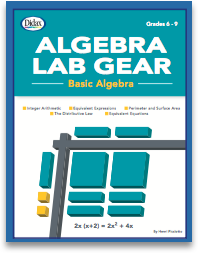
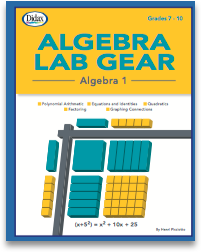
Two books are available from Didax: Algebra Lab Gear: Basic Algebra, and Algebra Lab Gear: Algebra 1.
Basic Algebra is intended for grades 6-9, and features activities on integer arithmetic, equivalent expressions, perimeter and surface area, the distributive property, and equivalent equations, as well as some "from blocks to symbols" pages.
Algebra 1 is intended for grades 7-10. It focuses on polynomial arithmetic, equations and identities, quadratics, factoring, and connections with graphing. It includes some lessons that I've used successfully in Algebra 2.
Both books have Common Core correlations, teacher notes, lesson plans, and answers. There is some overlap on the key concepts, but the two books are sequenced differently, and represent somewhat different pedagogic styles. If you can afford it, I recommend getting both so as to have more choices, and more activities on the most important topics.
Errata: Unfortunately, the first printings of the Algebra Lab Gear books included some mistakes. Download the corrected pages.
Alternative activity: I suggest an alternative to Activity 1-1D in the Algebra 1 book ("Face to Face") near the end of this blog post.
Free downloads: You can download Algebra Lab: High School. It is the first Lab Gear book, from 1990 -- it's not nearly as user-friendly as the Algebra Lab Gear books, but it's free. It contains some material available nowhere else and many activities I recommend for classroom use. In particular, check out the Explorations. (See pp. ix-x in the front matter for an overview and index of those.) Some of its content is sprinkled throughout Algebra: Themes, Tools, Concepts, a substantial textbook (1994), also available on this site.
