

Graphing
Ask students to line up along a line, which will be the x-axis. (The line at the middle of a basketball court works well, but any line will do.) They should all face in the same direction. The middle student will be 0, and students on his or her right will be 1, 2, 3, etc., while students on the left will be -1, -2, -3, etc. Then, say:
"y = 3, everyone takes 3 steps forward" (Pause, so the students can see where they are standing)
"Go back to the x-axis" (Pause)
"y = -2, everyone takes 2 steps backward" (Pause)
"Go back to the x-axis"
These initial two maneuvers should help students calibrate their steps with their neighbors, so that they end up on a line parallel to the x-axis with each.
Now say:
"y = 2x, everyone step 2 times your number -- forward or back, depending on whether 2 times your number is positive or negative!"
Presumably, students will be standing on the graph of y = 2x.
And so on, with different functions.
Depending on the functions you intend to use, you may allow students to bring paper and pencil and/or calculators in case they need to make calculations.
Note that for functions such as x^2 or 2^x you will need a lot of space!
Distance
These activities are best done in a gym or playground. Start before discussing circles, perpendicular bisectors, angle bisectors, etc. in a geometry class. It may be best to not do all of the activities in one session.
(I've done much of this with my own students, but not yet all.)
- Choose a student to be Point A. Ask the others to stand so that they are all at the same distance from Point A. Hopefully, they'll make a circle. Introduce the term "locus": the locus of points at a given distance from A is a circle with A as its center. (I usually say that "locus" is the mathematical term for "location". You can also just say "location" and wait for a future class to introduce "locus".)
- Choose two students to be points A and B. Ask the others to stand so that they are
- closer to A than to B
- closer to B than to A
- equidistant from A and B
- Choose three students to be points A, B, and C. Ask the others to stand so that they are
- closer to A than to B or C
- closer to B than to A or C
- closer to C than to A or B
- equidistant from A, B, and C
- Use a line on the floor or on the ground. Ask students to stand so that they are all at the same distance from the line. Discuss what "distance to a line" might mean. (If necessary, point out that a point's distance to a point on the line depends on which point is chosen on the line. What choice would make sense?)
- Choose one of the students to be Point O. Have another student stand on the line, as close to O as possible. Name that student Point P. Ask others to stand at the same distance from O as P is. Discuss.
- Use two intersecting lines on the floor or ground. If in a gym, you'll probably have to use existing painted perpendicular lines. If on the playground, you might be able to draw your own lines using carpenter's chalk. Name the lines L1 and L2. Ask students to stand:
- closer to L1 than to L2
- closer to L2 than to L1
- equidistant from L1 and L2
Extension beyond the usual geometry topics:
(Disclaimer: I have not yet actually done this with students. If someone tries it, let me know how it turns out!)
- Ask a student to be point F. Have that student stand a few steps away from a line. Ask students to stand
- closer to the line than to F
- closer to F than to the line
- equidistant from F and the line
- For this one, you will need a very long string. Ask two students to be points F1 and F2. They will each hold one end of the string close to their body. Ask other students to use the string in turn to find spots so that the sum of the distances to F1 and F2 is equal to the length of the string. Discuss.
Angles
At first, not all geometry students know what we're talking about when we talk about angles and their measures. This is probably why it is so difficult to teach some of them how to use a protractor: they don't know what they're measuring. Here are two kinesthetic activities that help a little, and a follow-up for precalculus.
Arm angles
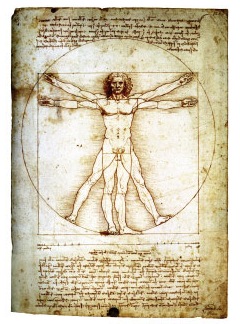
Ask the students to stand up, and stick an arm straight out so that it is neither horizontal nor vertical. (This helps separate the idea of "straight" from the idea of "horizontal or vertical". Students often confuse those.) Then ask them to stick the other arm out, so that their arms make an acute angle, a right angle, an obtuse angle. It is surprising how difficult this is for some students.
A payoff down the line is that arm angles can be used to introduce the idea of the intercepted arc. The arc intercepted by this angle is the part of the circle I can see between my two arms. This probably seems pointless to some of you, but a number of students have told me that this is what helped them see what was meant by the intercepted arc.
Walking polygons
This is based on turtle geometry as initially introduced by the Logo programming language, but it does not require a computer. A few "walking polygons" lessons are available in my Geometry Labs book. Here are two ideas:
- I tell students I will walk along the edge of an invisible parallelogram. Then I do the following, twice: two steps forward, a 135° turn to the left, one step forward, a 45° turn to the left. Of course it's not really possible for them to guess my turn angles, but it is entirely possible to figure out their sum, since after doing the two turns I'm facing in the opposite direction.
- Likewise, I tell them I'm going to walk a regular pentagon (or some other regular polygon -- preferably not a square.) At the end of the walk, I'm facing the way I faced at the beginning. This leads to a discussion of a formula for the size of the turn (or exterior) angle in a regular n-gon, and thus the size of the corresponding interior angle.
It is fun (and educational) to follow this up by programming a turtle in Logo or one of its descendants. (I use BYOB, a Logo descendant by way of Scratch.)
Radians
If radians are introduced strictly with a formula, the meaning of the word is difficult to grasp for many students. Some years ago, I learned two tricks from a colleague, which I'll share here:
- Tell students that "radian" is short for "radius angle".
- A one-minute kinesthetic activity: ask students to pair up with someone of roughly the same height. Student O will be the center of the circle, and stretch out an arm, which will be the radius. Student P will stand at that distance from O, and hold an arm out in a curvy way along the (unfortunately invisible) circle. Student O then stretches out the other arm towards student P's hand, thereby showing a central angle of one radian. (Of course, the point is not accuracy, which would be impossible to achieve, but to hammer home the point that a radian is a radius angle.)
Function Diagrams
I start by doing the "function diagram dance" for my students. The idea of the dance is that my right hand represents x and my left hand represents y. (From the student's perspective, this puts the x on the left and the y on the right, where they should be.) As I move my x hand from negative infinity (all the way down) to positive infinity (all the way up), I move my y hand in various ways, for example exactly along the x, for y=x, or consistently ahead of the x, for y=x+1, or twice as fast as the x for y=2x. Each time, the students have to figure out the function I am representing. (This only works for very simple functions, such as y=mx, or y=x+b.) After dancing some examples myself, I ask the students to do the dance, at first with functions similar to mine, then perhaps some new ones such as for example for y=-x and y=-2x.
I usually close the door right before doing this. This way they don't have to worry about being seen.
:)
Pascal's Triangle
Here's a possible way to introduce or review Pascal's Triangle.
(Disclaimer: I have not yet actually done this with students. If someone tries it, let me know how it turns out!)
- Have students stand in a triangular number arrangement
- Give the top student a penny.
- Give the top student another penny, and have him/her give the pennies, one each, to students in the next row
- Explain that this is what everyone will have to do: "when the time comes, give half of your pennies to each of the two students in the next row."
- Now give the top student two pennies, which get passed down to the next row, and from there to the next row, which gets us to 1 2 1
- Ask that row how many pennies they have altogether. Give that many pennies to the top student. Those should trickle down to 1 3 3 1.
- Ask that row how many they have, and give that many pennies to the top student.
- etc.
You get the powers of two pattern for free.